
A garden hose just moves dirt around. It doesn’t lift baked-on road film, brake dust packed into wheel wells, or bug splatter that’s been cooking on your bumper since last weekend’s drive. Without real pressure behind the water, you end up dragging a wash mitt through grit that scratches the clear coat instead of cleaning it.
An electric pressure washer for car detailing solves that without the noise, fumes, or maintenance of a gas unit. Plug it in, hook up a hose, and you get consistent pressure that breaks grime loose before your mitt ever touches the paint. For weekly driveway washes or full pre-wash foam sessions, electric models hit a sweet spot: enough force to actually clean, gentle enough not to strip wax when you use the right nozzle.
⏰ Today's Deal
Massive price drop for today only! Tap below to instantly check the current discount and grab yours on Amazon.
Check Price on Amazon As an Amazon Associate I earn from qualifying purchases.Not every pressure washer is built with car paint in mind, though. Some are tuned for concrete and siding and will happily etch trim or lift decals if you’re not careful. As one of the more practical vehicle upgrades and accessories you can add to a home garage, it’s worth choosing carefully. We looked at real ASIN listings, manufacturer spec sheets, and verified owner feedback to narrow this list to five electric washers that balance enough cleaning power with the control detailing actually requires.
🏆 Editor’s Top Pick
Sun Joe SPX3000 Electric Pressure Washer
The SPX3000 balances pressure, flow, and versatility better than anything else on this list, and its dual detergent tanks make switching between soap and rinse simple mid-wash.
- 2030 PSI / 1.76 GPM for real cleaning power without overkill
- 5 quick-connect nozzles including a dedicated low-pressure soap tip
- Dual 0.9 L detergent tanks for two cleaners on hand at once
- 34-inch stainless steel wand reaches wheel wells and rocker panels

Top 5 Electric Pressure Washers for Car Detailing Review
1. Sun Joe SPX3000 — Best Overall for Car Detailing
The SPX3000 has been a fixture in home garages for years, and for car care specifically, it’s the most balanced option here. The 14.5-amp motor puts out 2030 PSI at 1.76 GPM, which is enough to knock loose grime from wheel wells without the aggressive punch of a gas unit that can strip wax if you’re careless with the nozzle.
What sets it apart for detailing is the dual detergent tank system. You can load a snow-foam soap in one tank and a wheel cleaner in the other and switch between them with a dial instead of swapping bottles mid-wash. The 34-inch wand and 20-ft hose give enough reach to circle a full-size truck without dragging the unit around.
Key Features
- 2030 PSI / 1.76 GPM Motor — a 14.5-amp induction motor delivers steady pressure without bogging down mid-rinse.
- Dual Detergent Tanks — two 0.9 L onboard tanks hold separate cleaners, switchable via a dial.
- Total Stop System (TSS) — the pump idles automatically when you release the trigger, saving wear and energy.
- 5 Quick-Connect Nozzles — 0°, 15°, 25°, 40°, and soap tips cover everything from bug splatter to gentle rinsing.
- 34″ Stainless Steel Wand — long enough to reach under rocker panels and into wheel wells without crouching.
- 20-ft Hose / 35-ft GFCI Cord — enough combined reach to work around most vehicles from a single outlet.
Why We Recommend It
For a first pressure washer dedicated to car care, the SPX3000 removes the guesswork. The nozzle set covers everything from a pinpoint jet for baked-on tar to a wide fan for rinsing suds, and the dedicated soap nozzle means you’re not accidentally blasting detergent at full pressure.
It’s not the most rugged build in this lineup — the housing leans on plastic more than the Craftsman or Westinghouse units — but the motor and pump have a track record of outlasting the trim around them. The turbo-style nozzles also make quick work of brake dust, which matters if you’re regularly cleaning matte black rims that show grime more than gloss finishes.
Pros
- Dual removable detergent tanks for two cleaners at once
- 5 quick-connect nozzles including a dedicated soap tip
- 34-inch stainless steel wand reaches wheel wells easily
- 20-ft hose plus 35-ft GFCI cord for solid reach
- Backed by a 2-year warranty and CSA listing
Cons
- Housing feels more plastic than metal-frame rivals
- Hose has a reputation for kinking more than some competitors
What Customers Say

2. Westinghouse ePX3500 — Most Powerful
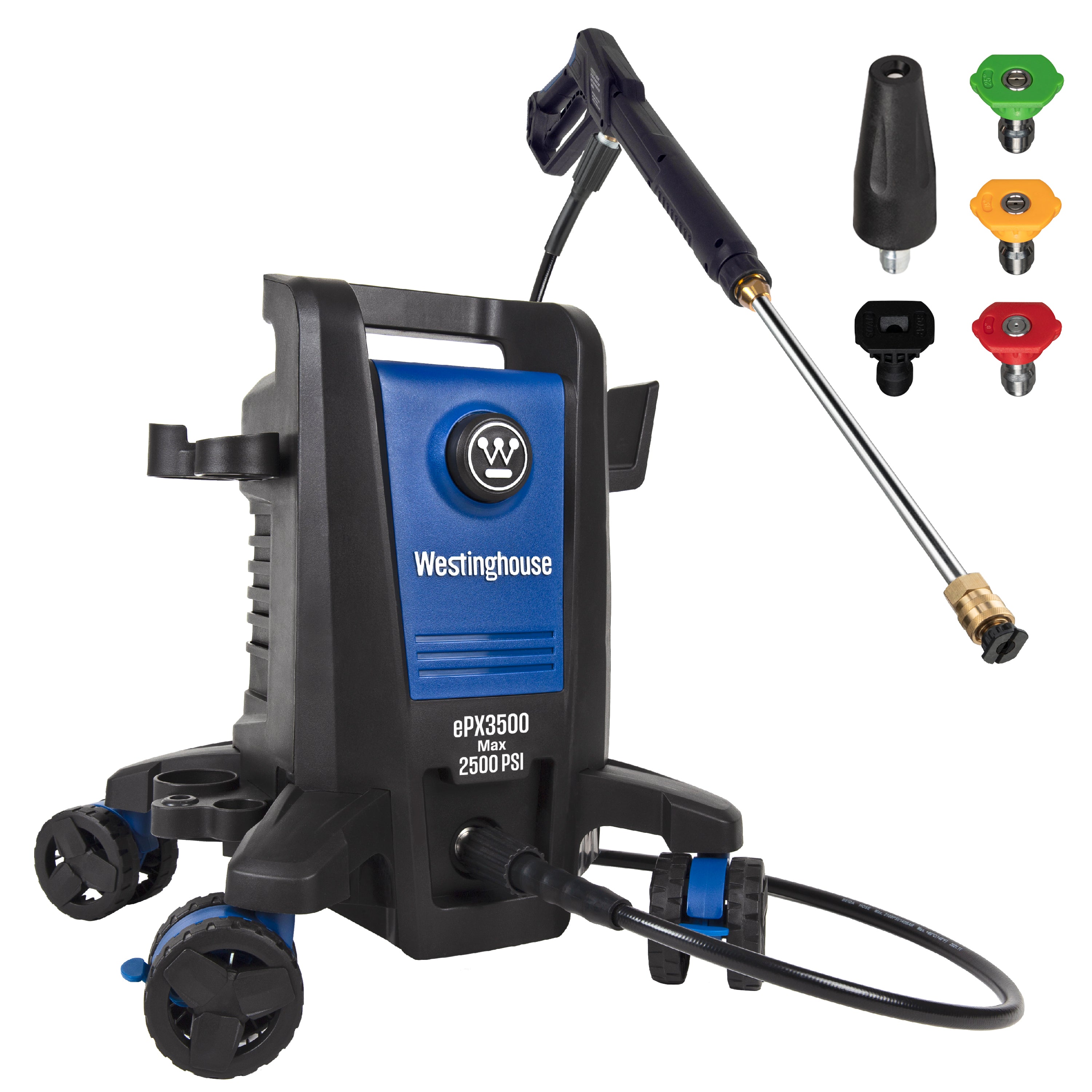
If you’re washing more than one vehicle, or dealing with a driveway that needs attention too, the ePX3500 brings more muscle. At 2500 max PSI and 1.76 GPM, it’s the strongest unit in this roundup, but its anti-tipping four-wheel design keeps it stable and easy to maneuver around a car despite the added power.
Weighing just 19 lbs and standing 16.5 inches tall, it’s surprisingly compact for its output. The 360° quick-lock wheels let you circle a vehicle without repositioning the whole machine, which matters when you’re working the same unit around wheel wells, rocker panels, and a hood in one session.
Key Features
- 2500 Max PSI / 1.76 GPM — the highest-output unit here, useful for mixed driveway-and-car duty.
- Anti-Tipping 4-Wheel Steering — a low center of gravity and 360° wheels keep it stable on uneven ground.
- Onboard 20 oz Soap Tank — built into the pro-style gun for quick detergent switching.
- 5 Quick-Connect Tips — 0°, 15°, 25°, turbo, and soap nozzles cover light to heavy tasks.
- 25-ft Easy-Coil Hose — nylon-braided and resistant to the kinking that plagues cheaper hoses.
- Total Stop System — automatically halts the pump between trigger pulls to extend its life.
Why We Recommend It
The ePX3500 is the pick if you want one machine that handles the car on Saturday and the patio on Sunday. Its extra pressure heads means you’ll want to default to the wider nozzles near paint and trim, but that same headroom makes quick work of caked mud on wheels and undercarriages.
Westinghouse backs it with a 3-year residential warranty, longer than most of the field here, which matters if this is going to see regular weekend use.
Pros
- Highest PSI/GPM combo in this lineup
- Anti-tipping 4-wheel steering for easy maneuvering
- Only 19 lbs and 16.5 in tall for storage
- Onboard 20 oz detergent tank built into the gun
- 3-year residential limited warranty
Cons
- No dual-tank soap switching like the Sun Joe
- Extra pressure means more caution needed near trim and decals
What Customers Say
3. Westinghouse ePX3100v — Best Foam Cannon Setup

The ePX3100v ditches the wheeled cart entirely and builds around a compact, carry-handle body that comes with a detachable foam cannon out of the box. For detailers who care more about a thick pre-wash foam layer than raw driveway-cleaning power, that’s the more useful combo.
At 17.6 lbs, it’s light enough to set on a shelf or in a trunk between uses, and the built-in handle means you’re not wrestling a cart over a curb to reach the far side of your car. It trades some hose length and nozzle variety for that portability, which is worth knowing before you buy.
Key Features
- 2100 Max PSI / 1.76 GPM — enough pressure for road grime without overwhelming a foam pre-wash routine.
- Detachable Foam Cannon — included standard, aerates soap into a clingy foam layer for pre-wash.
- Built-In Carry Handle — no cart to maneuver; pick it up and set it wherever you’re working.
- 17.6 lb Compact Body — among the lightest units here, easy to store in a garage corner.
- 3 Quick-Connect Nozzles — 15°, 25°, and turbo tips cover most detailing needs.
- 3-Year Limited Warranty — backed by Westinghouse’s nationwide service network.
Why We Recommend It
If your routine already centers on foam cannon pre-washes, buying a separate cannon attachment for a wheeled unit is an extra step this model skips. The trade-off is a shorter 20-ft hose and fewer nozzle options than the ePX3500 or SPX3000, so it suits a single-car garage more than a multi-vehicle household.
It’s also the pick for anyone tight on storage space — there’s no cart frame to find room for, just the unit itself.
Pros
- Detachable foam cannon included standard
- Built-in carry handle, no cart required
- Compact 17.6 lb body for easy storage
- 3 nozzle tips plus foam cannon cover most tasks
- 3-year warranty with nationwide service support
Cons
- 20-ft hose is shorter than the wheeled models here
- Only 3 nozzle tips versus 5 on other picks
What Customers Say
4. Greenworks 1800 PSI — Best Budget Pick

Not everyone needs 2000-plus PSI for a car that mostly stays under a carport. The Greenworks 1800 PSI unit is PWMA-certified and priced well below the rest of this list, making it a sensible entry point if you’re pressure-washing for the first time and want to see how it fits your routine before spending more.
It won’t chew through months of caked mud as fast as the higher-PSI options, but for regular maintenance washing on a car that isn’t neglected between cleanings, 1.1 GPM of flow at 1800 PSI is plenty. The push-button start and 20-ft hose-on-reel keep the whole setup simple.
Key Features
- 1800 PSI / 1.1 GPM (PWMA Certified) — independently rated performance, not just a marketing number.
- 13-Amp Universal Motor — enough draw for regular maintenance washing without tripping a standard outlet.
- Push-Button Start — no pull cords or priming rituals, just plug in and go.
- 20-ft Hose With Reel — keeps the hose from turning into a tangled mess in storage.
- Onboard Soap Tank — built-in detergent application for light soap work.
- 3-Year Limited Tool Warranty — solid coverage for a budget-tier unit.
Why We Recommend It
This is the washer to buy if you’re not sure pressure washing is going to become a regular habit, or if your main goal is a gentler weekly rinse rather than stripping months of grime. The lower PSI is actually an advantage for anyone nervous about damaging paint or wraps.
It comes with fewer nozzle tips out of the box than the pricier models, so budget a few extra dollars for a turbo nozzle if you want to tackle wheel wells more aggressively.
Pros
- Most affordable option in this lineup
- PWMA-certified rated performance, not just marketing specs
- Push-button start with no pull cords
- 20-ft hose with a reel for tidy storage
- 3-year limited tool warranty
Cons
- Lowest PSI/GPM combo of the five, slower on heavy grime
- Fewer nozzle tips included than pricier competitors
What Customers Say
5. Craftsman CMEPW2100 — Best for Easy Storage
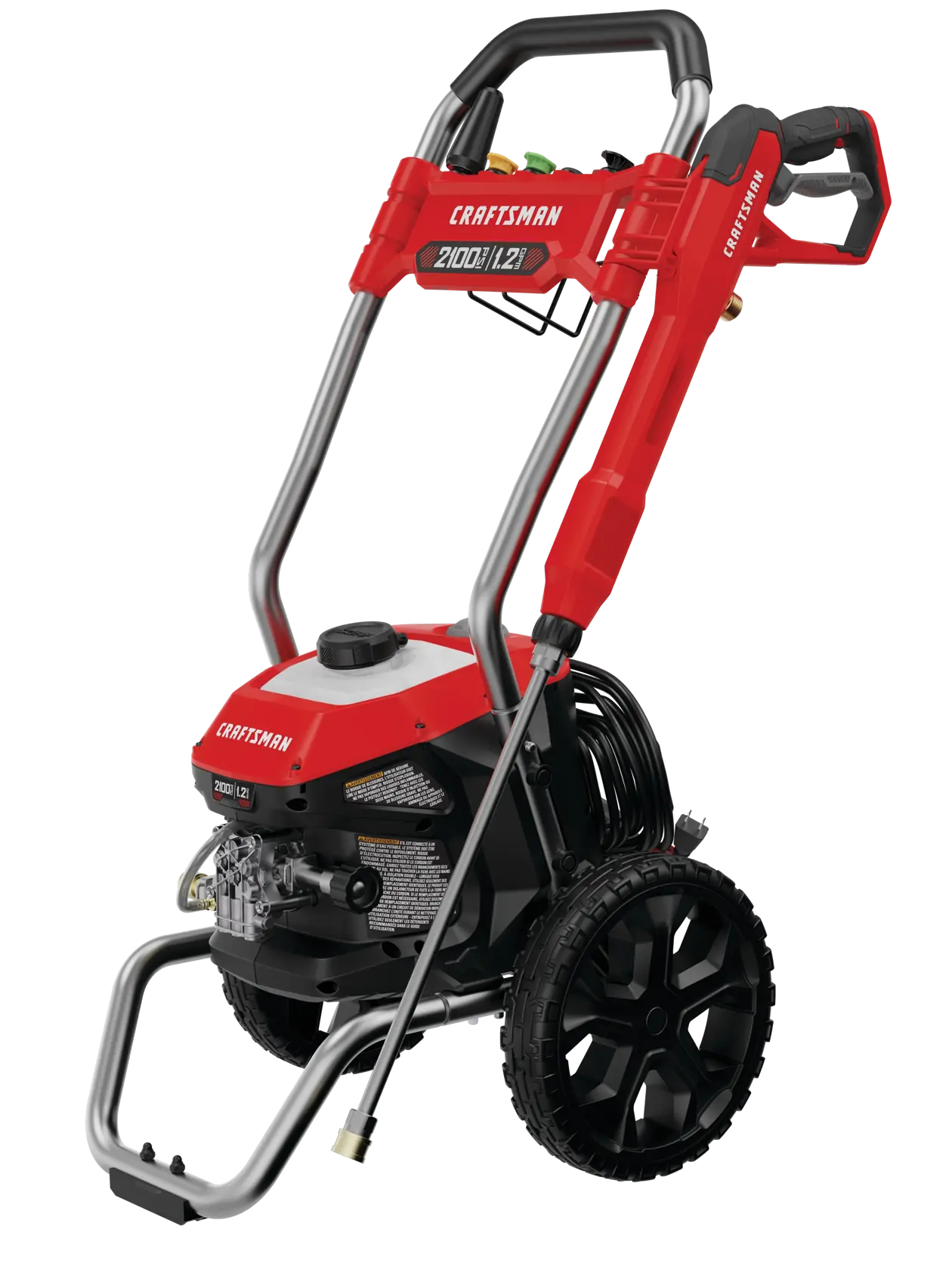
Craftsman leans on tool-heritage practicality here rather than raw output. The CMEPW2100 delivers 2100 max PSI and 1.2 GPM, but what stands out is how the whole kit stores itself: onboard racks for the hose, cord, wand, and nozzles keep everything in one place instead of loose in a bin.
The T-Rail Handle System locks the wand in place during transport, a small detail that matters if you’re wheeling it in and out of a garage regularly. It’s on the heavier side at roughly 29–35 lbs depending on the source, but the 10-inch wheels make that weight easy to manage.
Key Features
- 2100 Max PSI / 1.2 GPM — solid mid-range power for cars, siding, and driveways.
- T-Rail Handle System — locks the wand securely in place during transport.
- Onboard Storage — dedicated spots for the hose, cord, wand, and nozzles.
- 25-ft Kink-Resistant Hose — paired with a 35-ft power cord for good total reach.
- 10-in Wheels — larger wheels make it easier to roll over uneven garage floors.
- CETA Certified — meets Cleaning Equipment Trade Association performance standards.
Why We Recommend It
If you’re tired of hunting for a stray nozzle or untangling a hose every time you want to wash the car, this is the unit designed to solve that specific annoyance. The onboard storage genuinely keeps the whole kit together between uses.
It gives up a dual soap-tank system for a single integrated tank, so if you regularly switch between two different detergents mid-wash, the Sun Joe is the better fit.
Pros
- T-Rail handle system locks the wand for transport
- Onboard storage for hose, cord, wand, and nozzles
- 25-ft kink-resistant hose and 35-ft power cord
- 10-inch wheels roll easily over garage floors
- CETA certified for performance and safety standards
Cons
- Heavier than the Westinghouse ePX3100v at roughly 29-35 lbs
- No dual-tank soap switching like the Sun Joe
What Customers Say
How to Buy the Best Electric Pressure Washer for Car Detailing
Every unit on this list can clean a car, but they’re not interchangeable. Match the specs below to how you actually wash — frequency, vehicle size, and how much you value storage convenience over raw power.
Build Quality
Look for stainless steel wands and brass fittings over all-plastic connections; they resist the corrosion that comes from repeated soap and water exposure. Steel roll-cage frames like the Sun Joe’s also protect the pump housing if the unit tips over on uneven driveway pavement. A pressure wash also preps the surface well before any paint correction step that involves a cutting compound, since loose grit left on the panel causes swirl marks during polishing.
Performance
PSI measures force, GPM measures water volume — cleaning power is really a function of both together. For paint-safe car washing, 1800–2500 PSI at 1.1–1.76 GPM covers nearly every scenario without risking damage, which is why every pick here falls in that range. If wheel finish is a priority, it’s worth knowing the difference between matte black and gloss black wheels before picking a nozzle, since matte finishes are more sensitive to high-pressure jets at close range.
Size/Capacity
Detergent tank size and hose length decide how often you’ll stop mid-wash. Dual-tank systems like the Sun Joe’s let you switch cleaners without refilling, while a single 25-ft hose, like the Craftsman’s, usually reaches around a full-size vehicle without repositioning the unit.
Ease of Use
Push-button starts, Total Stop Systems, and onboard nozzle storage all reduce the friction of actually using the machine regularly. According to Consumer Reports’ testing, ease of assembly and operation consistently drives owner satisfaction more than raw spec numbers.
Warranty & Support
Warranties here range from 2 to 3 years. Westinghouse and Craftsman both offer 3-year residential coverage, longer than the Sun Joe’s standard 2-year term — worth weighing if this is a machine you expect to run every weekend.
Price vs. Value
Paying more buys you dual soap tanks, more nozzle variety, or better portability, not necessarily more power — most of these units cluster around 1800–2500 PSI. Full specifications for each model are available directly from the manufacturer, such as Westinghouse’s pressure washer lineup, if you want to compare beyond this list.
How to Use, Set Up, and Maintain Your Pressure Washer
How to Install
Setup on any of these units follows the same basic steps and takes about 10–15 minutes with no tools beyond what’s included. Get the wand, hose, and inlet connected before you plug anything in.
- Attach the spray wand to the trigger gun until it clicks or locks
- Connect the high-pressure hose between the pump outlet and the gun
- Attach a standard garden hose to the water inlet, checking for a clean filter screen
- Choose and snap on your first nozzle tip before powering on
How to Set Up / Tune
Before you ever pull the trigger with the machine running, purge air from the system — skipping this step is the most common cause of pulsating pressure or a pump that won’t build up force.
- Turn on the water supply fully before switching on the washer
- Squeeze the trigger for 20–30 seconds with the unit off to bleed air from the line
- Start with a wide-angle nozzle (25° or 40°) on painted panels, narrowing only as needed
- Load detergent only through the dedicated soap nozzle at low pressure
For a walkthrough of the Sun Joe SPX3000’s setup specifically, Sun Joe’s own official installation guide (“See the Video”) covers assembly start to finish.
How to Maintain
A pressure washer that sits in a cold garage over winter needs a little attention or the pump seals can crack. None of this takes more than a few minutes after each use.
- Drain the hose and pump after every wash so standing water doesn’t sit in the lines
- Rinse and inspect the inlet filter screen periodically for debris buildup
- Run pump-saver fluid through the system before winter storage if temperatures drop below freezing
- Store the unit indoors, away from direct heat sources that can dry out seals
Once the car itself is clean, protecting that fresh wash matters too — a good car cover for extreme sun keeps UV rays and dust off the paint between washes.
Frequently Asked Questions (FAQ)
Is an electric pressure washer safe for car paint?
Yes, as long as you use the right nozzle and keep reasonable distance. Wide-angle tips (25° or 40°) spread the pressure over a larger area and are the standard choice for painted panels; the narrow 0° jet is meant for concrete, not cars.
What PSI is too much for washing a car?
Most detailers stay under 2000–2500 PSI for painted surfaces, which is exactly the range this whole list falls into. Going much higher increases the risk of lifting decals, damaging trim, or etching clear coat if you hold the wand too close.
Can I use regular dish soap in a pressure washer?
It’s not recommended. Dish soap can foam excessively inside the pump and detergent lines, potentially damaging seals over time. Stick to detergents formulated specifically for pressure washers, which most manufacturers, including Sun Joe, sell directly.
Do I need a foam cannon, or is the built-in soap nozzle enough?
The soap nozzle on any of these units applies detergent fine for a quick wash. A foam cannon, like the one included with the Westinghouse ePX3100v, produces a thicker, clingier foam that dwells longer on the surface — useful for a proper pre-wash before you touch the paint with a mitt.
Why does my pressure washer lose pressure partway through washing?
The most common cause is a kinked inlet hose restricting water flow into the pump, followed by trapped air in the system. Straighten the hose, confirm the spigot is fully open, and re-purge the line by holding the trigger for 20–30 seconds before resuming.
Should I clean the interior too while I’m detailing?
A pressure washer is strictly an exterior tool — never use it inside the cabin. For interior surfaces like a sticky dashboard, stick to dedicated interior cleaners and microfiber cloths instead.
Final Verdict
For most people washing one or two vehicles regularly, the Sun Joe SPX3000 remains the strongest all-around choice — the dual detergent tanks and full nozzle set cover everything from a quick rinse to a full detailing session without needing a second machine or extra attachments.
If you want more raw power for a driveway that needs attention too, the Westinghouse ePX3500 delivers the highest pressure here without sacrificing stability. Detailers who build their routine around a foam pre-wash will get more direct value from the ePX3100v’s included cannon than from any wheeled unit’s extra hose length.
Budget-conscious buyers shouldn’t feel like they’re settling with the Greenworks 1800 PSI model — PWMA certification means the numbers are independently verified, not inflated marketing specs. And if garage clutter is your real enemy, the Craftsman CMEPW2100’s onboard storage solves a problem the other four don’t directly address. Whichever you choose, match the nozzle to the surface and you’ll get years of use without a single scratch in the clear coat.

Leave a Reply