
Trapped air ruins more coolant jobs than bad parts do. You drain the system, pour in fresh coolant, and still fight a cold heater or a climbing temperature gauge for days. Worse, those air pockets can mimic a bad water pump. A coolant system vacuum filler solves this problem by pulling air out first, then drawing coolant in under vacuum.
This category matters because modern engines hide air traps. Turbo plumbing, high-mounted reservoirs, and long heater loops all hold bubbles that burping never clears. Most vacuum fillers run on shop air and cost far less than a flush machine. Many also double as a leak checker, since a system that cannot hold vacuum has a leak somewhere in the loop.
We narrowed the field to five coolant vacuum refill kits sold on Amazon. Each one earned its spot through verified specifications, real owner feedback, and clear trade-offs. Some suit a home garage. Others hold up in a busy shop. The list is ranked, and we explain every placement. Read on to match the right radiator vacuum fill tool to your vehicle, your compressor, and your budget.
🏆 Editor’s Top Pick
OEMTOOLS 24444 AirEvac Cooling System Refiller Kit
The OEMTOOLS 24444 gives you the best mix of price, proven reviews, and simple operation. Its universal cone and five bushings fit most radiator necks, and the built-in gauge lets you leak-test before filling. It is the easiest recommendation for home mechanics.
- Venturi vacuum runs on shop air
- Tapered cone plus five rubber bushings
- Built-in vacuum gauge for leak tests
- Filtered antifreeze pick-up hose
Top 5 Coolant System Vacuum Filler Reviews
1. OEMTOOLS 24444 AirEvac Kit — Best Overall Value
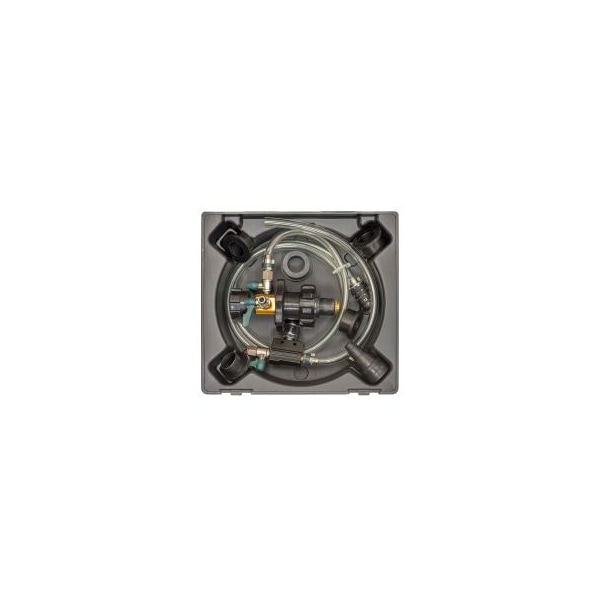
The OEMTOOLS 24444 is a venturi-style coolant vacuum refill kit that runs on shop air. It pulls vacuum, holds it for a leak check, then draws coolant from your jug through a filtered hose. It targets home mechanics and small shops that want air-free fills without professional-tool prices.
You will need a right-sized air compressor, because the venturi valve turns compressed air into suction. The included bushings and cone adapter cover most radiator and reservoir necks. Expect a one-year limited warranty, which is shorter than some rivals offer.
Key Features
- Venturi Vacuum Valve — turns shop air into strong suction, so you need no electric pump. Hook it to a compressor and pull vacuum in minutes.
- Built-In Vacuum Gauge — shows whether the system holds vacuum, so you catch a leaking hose or cap before adding coolant.
- Five Bushings and Tapered Cone — the 31, 35, 40, 42, and 45 mm rubber bushings seal most radiator and coolant bottle necks without custom adapters.
- Filtered Pick-Up Hose — the antifreeze hose includes a filter, which keeps debris from the jug out of your cooling system.
- Muffler and Storage Case — a muffler dampens exhaust noise, and the molded case keeps every part together in the toolbox.
Why We Recommend It
Buy this kit if you change coolant a few times a year and want a dependable result. One 2026 roundup calls it the best-selling coolant vacuum refill kit on Amazon, with about 2,300 reviews and a 4.4-star average.
It earned the top ranking for balance. It costs less than brass shop tools, yet still gives you a gauge, a leak test, and a clean fill. High-volume shops may prefer a faster tool.
Pros
- Universal cone plus five bushings fit most necks
- Built-in gauge enables vacuum leak tests
- Runs on shop air, so no pump is needed
- Filtered pick-up hose is included
- Large owner base with about 2,300 Amazon ratings
Cons
- Requires a shop air compressor
- Only a one-year limited warranty
What Customers Say
A member of the Ty4Stroke forum linked this kit on Amazon and called it a “great addition to the toolbox” for anyone doing their own repairs.
A Land Rover World forum member used the OEMTOOLS 24444 from Amazon to bleed the coolant on a 2014 LR4 and shared it as a recommended method.

2. UView 550000 Airlift — Best Premium Pick

The UView 550000 Airlift is the tool many shops measure others against. It uses shop air to pull vacuum, checks for leaks, and refills the system, including the heater core, in under two minutes, according to the listing. It suits technicians and serious DIYers who want a brass, OEM-approved tool.
It needs at least 90 psi of shop air, and one owner noted the air fitting is not included. The price also runs higher than economy kits. Those trade-offs make sense if you service vehicles weekly. Home users who refill once a year may find it overbuilt.
Key Features
- OEM-Approved Design — the Amazon listing calls it OEM approved, which matters on engines where trapped air can cause costly damage.
- Brass, All-Metal Build — brass fittings resist wear in a shop, and one owner reported weekly use for over ten years.
- Leak Test Under Vacuum — hold the vacuum first. If the needle drops, you have a leak to fix before you add coolant.
- Full-Loop Heater Core Fill — vacuum reaches the whole circuit, so cabin heat returns without repeated burping.
- Universal Connectors — retailer listings describe use on cars, trucks, and off-road vehicles, which makes it a flexible shop tool.
Why We Recommend It
Pick this tool if you do coolant service often and value longevity over price. It ranks second because it beats nearly every kit on durability, yet it costs more than the OEMTOOLS and wants a stronger compressor.
The feedback backs the ranking. Buyers on eBay gave it 4.8 out of 5 across 25 ratings, and one Garage Journal member called it the gold standard.
Pros
- OEM-approved design
- Brass, all-metal construction
- Built-in vacuum leak test
- Refills the heater core in minutes
- Owners report years of weekly use
Cons
- Needs 90 psi shop air and a separate air fitting
- Costs more than economy kits
What Customers Say
An eBay buyer who used the Airlift weekly for about ten years described the “brass construction built like a tank.”
A Garage Journal forum member who has owned theirs for years called it the “gold standard for vacuum fill.”
3. UView 550500 Airlift II Economy — Best for Home Garages
The Airlift II Economy trims cost and weight from the original design. A push-button valve switches between vacuum and fill without swapping hoses, and a fits-all cone seals most reservoirs. It suits DIYers who want the UView method in a lighter tool.
FCP Euro’s product team lists 90 psi at 4.2 cfm, though a small compressor works if you pause to let it recharge. Buy a 1/4-inch air chuck, since none is included. It works well after a water pump job, a hose change, or a thermostat upgrade.
Key Features
- Push-Button Valve — switches from vacuum to fill without changing hoses, which keeps the vacuum intact during the swap.
- Fits-All Cone Adapter — seals most filler necks and reservoirs, so you avoid hunting for the right bushing size.
- Leak Check Under Vacuum — hold the vacuum and watch for loss. One reviewer found three leaks in a small system this way.
- Compact, Light Body — it weighs under two pounds and fits a drawer, though the upper body is plastic rather than brass.
- Heater Core Refill — the maker says it refills the entire system, including the heater core, in seconds.
Why We Recommend It
Choose this tool if you want the Airlift workflow at a friendlier price. It ranks third because the plastic upper body and missing air fitting trail the metal original.
FCP Euro’s team says it also works through an expansion tank when the included adapter seals properly, which helps on many European cars.
Pros
- Push-button valve avoids hose swaps
- Fits-all cone suits most reservoirs
- Vacuum hold test reveals leaks
- Light, compact body
- Refills the heater core under vacuum
Cons
- Plastic upper body is less rugged than brass
- No air fitting is included
What Customers Say
An FCP Euro customer said the tool “works great,” refilled coolant quickly without air pockets, and exposed a leak during the vacuum check.
A Desertcart reviewer called it “a must for mechanics” after water pump, hose, or thermostat work.
4. Orion Motor Tech 31-Piece Coolant Pressure Tester & Vacuum Refill Kit — Best Combo Kit

This kit packs a pressure tester and a vacuum fill tool into one case. The vacuum tool shares 22 snap-on adapters with the pressure pump, plus a universal adapter. It suits owners of mixed European and domestic vehicles who also need to hunt leaks.
The seller lists a vacuum gauge range of 0 to -30 inHg and a hand pump up to 35 psi. Fit varies by vehicle. One buyer said some adapters need improvising, and another advised catching coolant mist from the air outlet in a container.
Key Features
- 22 Adapters Plus Universal — color-coded snap-on adapters cover major makes such as BMW, Ford, VW, Porsche, and Mercedes-Benz.
- Pressure Test and Vacuum Fill — find a leak with the hand pump, then refill under vacuum using the same adapters.
- Vacuum Purge Tool — its gauge reads 0 to -30 inHg, so you can confirm the system holds vacuum before adding coolant.
- Metal and Brass Parts — the seller lists aluminum alloy, nylon, brass, and rubber, which should handle repeated shop use.
- Thermometer and Molded Case — the set adds a probe thermometer, wrench, hoses, O-rings, and a custom case for storage.
Why We Recommend It
Buy this if you want one case that diagnoses and fixes the problem. A single kit covers testing and filling, which saves money for owners with several vehicles.
It ranks fourth because it takes more setup than a dedicated airlift tool, and adapter fit varies by vehicle. Test the seal before you drain any coolant.
Pros
- 22 adapters plus a universal adapter
- Pressure testing and vacuum filling in one kit
- Vacuum gauge reads 0 to -30 inHg
- Includes thermometer, wrench, and hoses
- Custom molded carrying case
Cons
- Adapters do not fit every vehicle
- Air outlet can spray coolant mist
What Customers Say
A Desertcart reviewer who vacuum-filled a 2015 LR4 and pressure-tested a 2007 Impala said they were “very pleased with this tool.”
An eBay buyer reviewing the Orion Motor Tech kit in Spanish gave five stars and called the quality “muy buena” (very good), adding the slight shipping delay was worth it.
5. Mishimoto MMTL-CPT-28 — Best Lifetime-Warranty Kit
Mishimoto pairs a 28-piece pressure tester with vacuum purge and refill tools. The kit has 17 color-coded adapters and test caps, and the pressure side works from 0 to 35 psi. It suits enthusiasts with domestic cars and light trucks who want a branded, backed kit.
It is not built for big on-highway trucks. A Mishimoto representative said so on a Diesel Power Products Q&A, and one owner reported leaking quick-release fittings on a 7.3L F250. The case is also large, at about 11 pounds.
Key Features
- 17 Color-Coded Adapters — match the neck size by color, which speeds up the fit on imports and domestics.
- Radiator Cap Test Caps — check the cap on its own, since a weak cap is a common cause of overheating.
- Vacuum Purge and Refill Tool — pulls air out first, so you skip long bleeding sessions. It connects to your compressor.
- 0–35 psi Pressure Testing — the hand pump and hose reveal leaks on a cold engine, before you start a messy repair.
- Lifetime Warranty and Case — Mishimoto backs the kit for life, and the case holds the thermometer, wrench, and fittings.
Why We Recommend It
Choose this if you want a full diagnostic set from a cooling-focused brand. Its lifetime warranty and a 4.8-star average across 80 reviews on Throtl set it apart.
It ranks fifth only because it carries more parts than a refill-only job needs. For mixed testing and filling, it is hard to fault.
Pros
- Mishimoto lifetime warranty
- 17 adapters plus radiator cap test caps
- Pressure testing from 0 to 35 psi
- Vacuum purge and refill tools included
- Thermometer, wrench, and molded case included
Cons
- Not designed for larger on-highway trucks
- Bulky, roughly 11-pound kit
What Customers Say
An eBay reviewer with a Jeep JK pulled vacuum easily with a home compressor and said it beat refilling with a funnel.
A Desertcart reviewer called it a “great tool worth the money” after pressure testing located a coolant leak.
How to Buy the Best Coolant System Vacuum Filler
A good coolant system vacuum filler saves hours, but specs differ more than listings suggest. Use these six checks to choose the best coolant vacuum refill kit for your garage.
Build Quality
Metal fittings last longer than molded plastic, especially around hot coolant and shop air. Brass, like the UView 550000, shrugs off years of weekly use. Rubber bushings wear first, so check that replacements exist. Look for a gauge in a rubber boot and a quick-connect that seals cleanly. Weak seals leak vacuum and ruin the whole fill. Always inspect O-rings before each job.
Performance
Performance comes down to vacuum depth and hold time. Venturi tools run on compressed air, so check the pressure each one needs. UView lists a 90 psi minimum for the 550000. A small compressor still works, but it pauses to recharge. Mastercool’s instruction sheet suggests watching the gauge for about ten minutes to confirm the system holds vacuum. A slow drop means a bad hose or cap, not a bad tool.
Size / Capacity
Capacity here means neck coverage, not volume. Your tool must seal the reservoir, whether it is a threaded neck, a degas bottle, or a pressurized tank. Universal cones help, and extra bushings add range. Combo kits weigh about eleven pounds. Compact airlifts fit a drawer. Turbo cars may also run a separate loop, so see how a radiator and intercooler differ before filling.
Ease of Use
Simple tools win on cold mornings. A push-button valve, like the Airlift II’s, keeps vacuum intact while you switch to filling. Clear gauges make the hold test easy to read. Check for an included air fitting, since several kits omit one. Fewer parts mean fewer mistakes. MOTOR’s overheating diagnosis guide also calls vacuum purging the surest way to get an air-free system.
Warranty & Support
Warranties vary widely. Mishimoto backs its kit for life, while OEMTOOLS lists a one-year limited warranty. Check the return window too, because adapter fit is a common complaint in owner feedback. Buy from a seller with easy returns in case a cone or bushing does not seal on your vehicle. Keep your receipt, and do a dry fit before you drain any coolant. A dry fit takes two minutes.
Price vs Value
Price spans a wide range, so match the tool to your workload. OEMTOOLS usually costs least and suits occasional use. The Airlift II Economy sits in the middle, and the UView 550000 costs more but suits weekly service. Combo kits add pressure testing, which is worth paying for only if you diagnose leaks. Skip features you will never touch. Check current Amazon pricing, since it changes often.
How to Install, Set Up, and Maintain a Coolant System Vacuum Filler
How to Install
A vacuum filler does not bolt on. You seat it on the reservoir or radiator neck and hook it to shop air. Work on a cold engine, and wear gloves and eye protection. See the Video linked from FCP Euro’s UView Airlift II page for a visual walkthrough.
- Let the engine cool fully, then remove the radiator or reservoir cap.
- Pick the bushing or cone that seals tightly on the neck.
- Attach an air fitting to the tool’s inlet, because many kits do not include one.
- Route the air outlet into a small container to catch coolant mist.
- Replacing a Dodge radiator? Our guide on removing transmission cooler lines covers the disconnect step.
How to Set Up / Tune
Setup is mostly about sequence. Seal the neck, pull vacuum, hold it, then open the coolant valve. Keep the pick-up hose submerged so no air enters. Most tools need roughly 90 psi of compressed air, so confirm your regulator setting before you start.
- Close the coolant valve and submerge the pick-up hose in a jug of premixed coolant.
- Connect shop air and watch the gauge climb toward full vacuum.
- Shut off the air and hold vacuum for several minutes. A falling needle means a leak.
- Open the coolant valve and let the vacuum draw coolant in.
- Keep the hose filter submerged. If the jug runs low, close the valve and re-establish vacuum.
- Top off the reservoir, start the engine, and check heater output.
How to Maintain
Coolant is corrosive, and dried residue damages seals. OEMTOOLS’ manual says to wash hoses and adapters with water after each use, then dry every part before storage. Treat any brand the same way, and your tool will last for years.
- Rinse hoses, bushings, and the cone with clean water.
- Dry all parts before returning them to the case.
- Inspect O-rings and rubber bushings for cracks or flat spots.
- Replace the pick-up filter if it clogs.
- Protect the gauge from drops, and run a quick vacuum test before big jobs.
Frequently Asked Questions
Do I need an air compressor for a coolant vacuum filler?
Most venturi-style kits, including the OEMTOOLS 24444 and the UView Airlifts, run on shop air, so yes. UView lists a 90 psi minimum for the 550000. FCP Euro says a small two-gallon compressor works but needs pauses to recharge.
Can a vacuum filler find coolant leaks?
Yes. If the system cannot hold vacuum, a leak exists somewhere. One reviewer found three leaks in a small system after a vacuum test. Combo kits also add pressure testing for harder-to-find leaks.
Will it fill the heater core too?
Yes, because vacuum reaches the whole loop. UView says its Airlift tools refill the entire system, including the heater core. Large diesel systems may take longer. One eBay reviewer said a Powerstroke needed two vacuum sessions.
Does it work on a degas bottle or expansion tank?
Usually, if the cone or bushing seals the opening. FCP Euro’s team says the Airlift II works at an expansion tank when the included adapter seals properly. Big on-highway trucks may need UView’s heavy-duty version, since Mishimoto says its kit is not designed for them.
Is vacuum filling better than burping the system?
Vacuum filling removes air before coolant enters, so it avoids the long bleed cycle. A Garage Journal member who works on heavy equipment says some engines with EGR coolers require vacuum filling because air pockets can cause failure. Always check your service manual for the correct procedure.
Final Conclusion
A coolant system vacuum filler turns a frustrating job into a routine one. It removes air before coolant enters, so you skip the long burping cycle and the guesswork. For most home mechanics, the OEMTOOLS 24444 delivers the best balance of price, features, and proven owner feedback.
Frequent users should look at the UView 550000 for its brass build, or the Airlift II Economy for a lighter option. Owners who also chase leaks will like the combo kits from Orion Motor Tech and Mishimoto. Pair any of them with a dependable compressor, such as a Central Pneumatic air compressor, and you are set.
Check your service manual, confirm your neck size, and use the Amazon links above to compare current prices. A good radiator vacuum fill tool pays for itself after a single coolant change. Fill air-free once, and you will not want to go back to the funnel.

Leave a Reply