
If your factory stereo sounds flat, muddy, or just “off” no matter how good your speakers are, the problem usually isn’t your gear. It’s the lack of a digital signal processor tuning the signal before it ever reaches your amplifier. A DSP is the piece that fixes time alignment, corrects the factory EQ curve, and lets every speaker in the car work together instead of fighting each other.
Car cabins are acoustically brutal. Glass reflects sound, seats are off-center, and every dashboard shape changes how frequencies bounce around. A DSP can’t change the shape of your car, but it can compensate for it with crossovers, time delay, and parametric EQ tuned specifically to where you sit. That’s the difference between a system that’s loud and one that actually sounds right.
⏰ Today's Deal
Massive price drop for today only! Tap below to instantly check the current discount and grab yours on Amazon.
Check Price on Amazon As an Amazon Associate I earn from qualifying purchases.We tested and researched dozens of car audio DSP processors currently sold through major retailers, cross-checking specs against manufacturer data sheets and real owner feedback from Amazon, enthusiast forums, and installer communities. The five Car Audio DSP processors below cover every budget and use case, from a $200 entry point to a full DSP-and-amplifier combo.
Top 5 Car Audio DSP Processor Reviews
1. AudioControl DM-810 — Best Overall
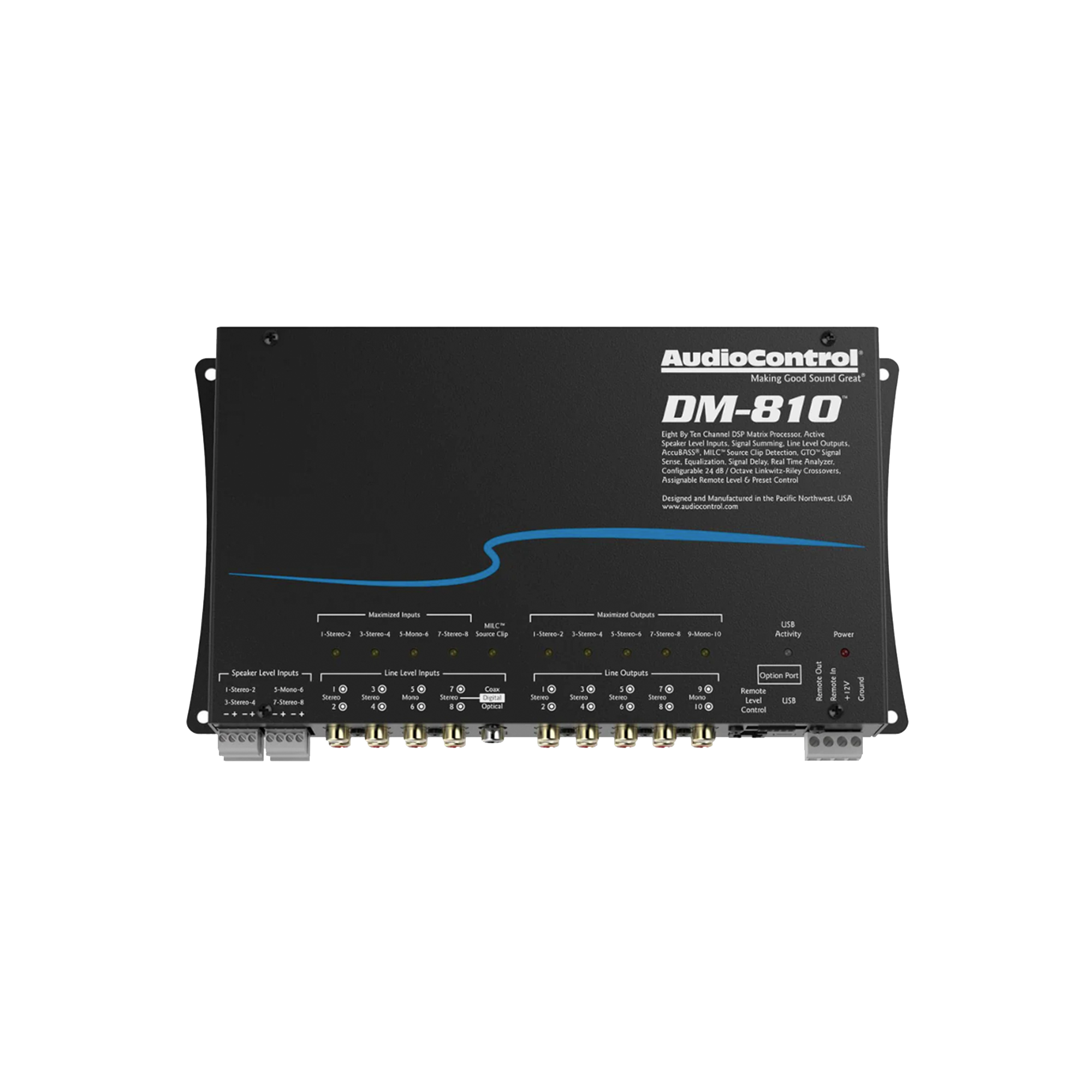
The DM-810 is AudioControl’s flagship matrix processor, built for anyone who wants total control without abandoning their factory head unit. It takes 8 inputs and routes them across 10 outputs, with signal summing that lets it pull a clean signal straight from a factory amplified system. That’s the feature that separates it from cheaper DSPs.
It’s aimed at enthusiasts building serious active systems, whether they’re keeping the factory radio or running aftermarket sources. Real-world tuning is handled through AudioControl’s DM Smart DSP software, which works on Mac, PC, iOS, and Android. Expect a short learning curve if this is your first DSP, but the payoff in OEM sound quality is significant.
Key Features
AccuBASS automatically restores low-end punch that factory systems often strip out at low volumes, so bass doesn’t disappear when you’re driving quietly. GTO Signal Sense detects an incoming audio signal and turns the unit on automatically, no separate remote-turn-on wire required in most factory installs.
MILC (Maximum Input Level Control) watches for clipping on the incoming signal and lights up an LED warning before distortion becomes audible, which takes the guesswork out of gain-setting. The 30-band parametric EQ per channel, paired with input and output RTAs, lets you see exactly what the factory system is doing to the signal and correct it precisely.
Why We Recommend It
Anyone integrating a serious component and subwoofer system with a factory head unit should start here. The DM-810 earned the top spot because it balances real OEM integration tools, a genuinely useful app, and enough EQ and crossover depth for advanced tuning, all without requiring you to rip out the factory radio.
Pros
- 8×10 matrix with true signal summing for clean factory-amp integration
- AccuBASS, GTO Signal Sense, and MILC clip detection built in
- 30-band parametric EQ per channel plus input/output RTA for precise tuning
- DM Smart DSP app works on Mac, PC, iOS, and Android
- Option Port allows future hi-res streaming and Bluetooth programming expansion
Cons
- 24-bit/48kHz processing trails newer 32-bit/96kHz competitors
- Software has a real learning curve for first-time DSP users
What Customers Say
A verified buyer on SonicElectronix.com said the build quality was solid and installation straightforward, though the tuning software took some time to click before the results felt worth it.
A customer review on OnlineCarStereo.com described using the DM-810 to fix a muddy factory Sony system in a Ford, calling the price steep but the improvement in clarity worth every penny.
2. Rockford Fosgate DSR1 — Best for Factory Head Unit Integration

The DSR1 is built specifically to replace a factory amplifier without losing factory features. Its integrated iDatalink Maestro module can be flashed with vehicle-specific firmware for select Ford, Chrysler, Toyota, Subaru, and Nissan platforms, letting it read the factory CANbus and route audio without disturbing steering-wheel controls or chimes.
It’s the pick for drivers who want to replace a weak factory amp and speakers but keep everything else stock. Tuning happens entirely through Rockford’s PerfectTune app over Bluetooth, so no laptop is required. With 245 bands of equalization across the system, there’s plenty of room to fix a harsh factory EQ curve.
Key Features
The flashable Maestro module is the headline feature: instead of a universal high-level input, it can talk directly to compatible factory head units on a vehicle-specific T-harness, preserving OEM functions that generic DSPs often break. That makes it genuinely plug-and-play on supported vehicles rather than a workaround.
Bluetooth 4.0 connectivity means setup and adjustments happen from a phone in the driver’s seat, with 31 bands of parametric EQ per channel group and up to 10ms of time delay for alignment. The compact 1.26 x 4.04 x 5.12-inch chassis tucks behind almost any dash.
Why We Recommend It
If your vehicle is on Rockford’s supported list, the DSR1 removes most of the pain typically associated with DSP installs. It’s the right call for anyone who wants a real upgrade in sound without hunting for dash kits or losing factory convenience features in the process.
Pros
- Integrated iDatalink Maestro module retains factory controls on supported vehicles
- 245 bands of equalization for deep tuning flexibility
- PerfectTune app (iOS/Android) tunes the system without a laptop
- Bluetooth 4.0 setup connectivity for wireless configuration
- Compact chassis fits easily behind most factory dashboards
Cons
- Full Maestro integration only applies to specific supported vehicle platforms
- 8 output channels limit very complex multi-amp active builds
What Customers Say
A verified buyer review on RockfordFosgate.com described switching from a laptop-based DSP to the DSR1 and preferring the iPad/iPhone tuning workflow, specifically praising the 31 bands of parametric EQ per channel.
Another verified reviewer on the same site called it compact, light, and simple to install, with results that matched more expensive laptop-tuned processors.
3. Alpine PXE-C80-88 OPTIM8 — Best DSP + Amplifier Combo
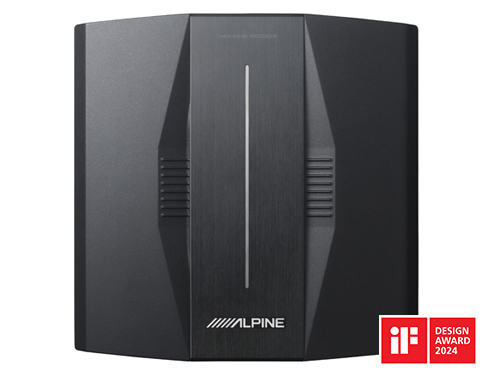
The OPTIM8 folds an 8-channel DSP and an 8-channel amplifier into one chassis, which matters if space or wiring complexity is your biggest obstacle. It outputs 50 watts x6 plus 300 watts x2 into 2 ohms, enough to run a full component-plus-subwoofer system without a separate amp taking up trunk space.
It’s aimed at people upgrading a factory or aftermarket system who want automatic tuning instead of a manual, mic-and-software process. The Alpine OPTIM app walks you through a guided measurement using a phone or the included KTX-CSP1 microphone kit, and AutoEQ 2.0 does the heavy lifting from there.
Key Features
Center Image Mode is the standout: with one tap, it adjusts time alignment and frequency response so vocals and instruments sit centered on the dash instead of pulling toward whichever speaker is closest to the driver. Four target curve presets let you switch between tuning profiles for different music styles from the included remote.
Anti-EQ mode cancels out a factory head unit’s built-in EQ curve before AutoEQ applies its own correction, which matters because factory systems often pre-boost bass and treble in ways that fight a DSP’s tuning. Hi-Res 96kHz/24-bit processing and 31-band parametric and graphic EQ back up the automated tools with manual control when you want it.
Why We Recommend It
Anyone who wants professional-grade tuning without paying an installer to run a full manual RTA session should look here. The built-in amplifier also means one less component to mount and wire, making the OPTIM8 the simplest path to a genuinely tuned system in a compact install.
Pros & Cons
Pros
- Built-in 8-channel amplifier (50W x6 + 300W x2) eliminates a separate amp
- AutoEQ 2.0 self-tuning via smartphone measures the cabin and adjusts automatically
- Center Image Mode auto-corrects time alignment for a centered soundstage
- Hi-Res 96kHz/24-bit processing with 31-band parametric and graphic EQ
- Anti-EQ mode cancels out factory head unit EQ curves for cleaner OEM integration
Cons
- Built-in amplifier power is modest for large, power-hungry component setups
- All-in-one design offers less flexibility than mixing separate amp brands
What Customers Say
Members of the DIYMobileAudio.com car stereo forum who bench-tested the OPTIM8’s power and distortion figures noted that its auto-tune feature produced decent, usable results and that the DSP chip appeared capable of both FIR and IIR filtering.
One forum member specifically pointed to the auto-tune’s real-time target-curve editing as a standout over similar automated processors they had tried.
4. AudioControl DM-608 — Best Mid-Range
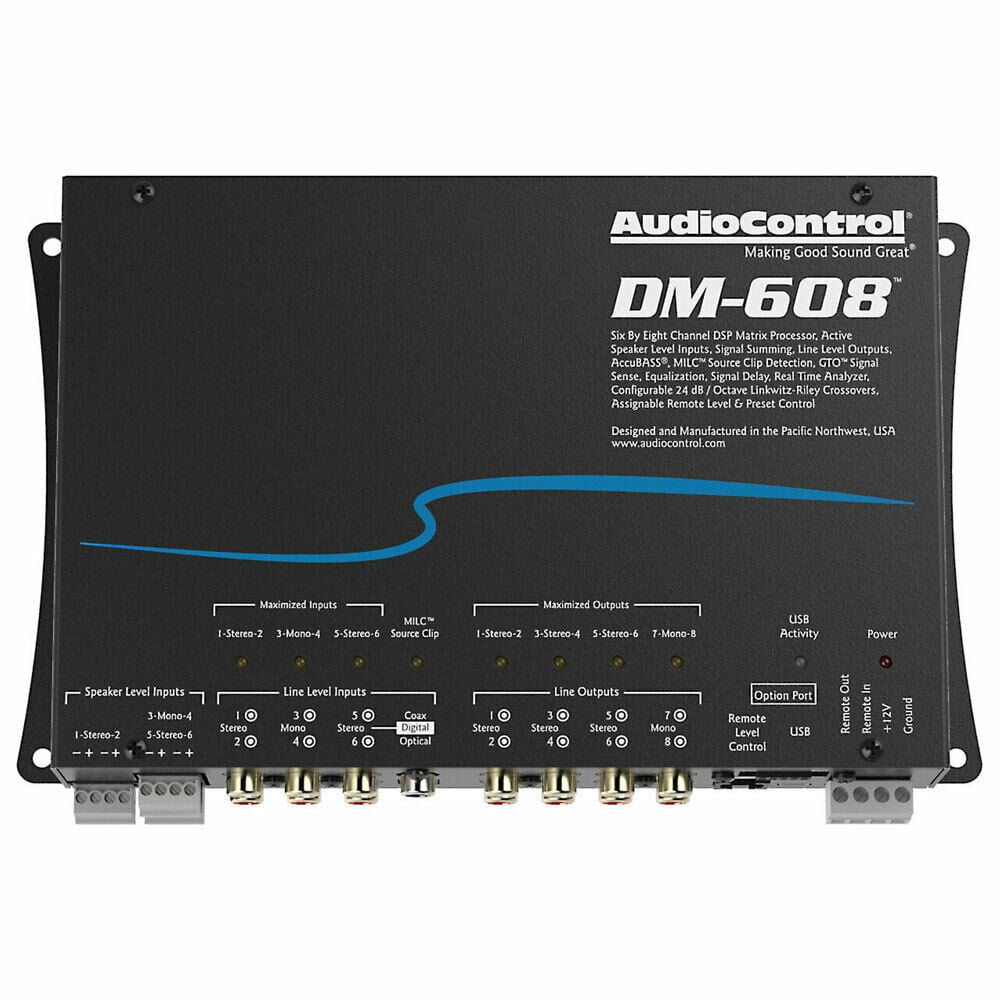
The DM-608 is the smaller sibling to the DM-810, trimmed down to 6 inputs and 8 outputs while keeping AudioControl’s core OEM integration toolkit intact. It’s built for systems that don’t need the DM-810’s extra headroom but still want signal summing, RTA metering, and the same proprietary bass and clip-detection features.
It suits installs with a factory head unit and a moderate active system, typically 2-way front components plus a subwoofer channel, where 6 inputs and 8 outputs cover every zone. Note that availability has tightened at some retailers as AudioControl has shifted focus to the DM-810, so check current stock before planning around it.
Key Features
AccuBASS, GTO Signal Sense, and MILC clip detection carry over directly from the DM-810, giving the DM-608 the same automatic bass restoration and turn-on behavior at a lower price point. The 30-band parametric EQ and dedicated input/output RTA give installers the same visibility into what the factory system is doing to the signal.
AudioControl’s Smart User Interface software runs on PC or Mac, with an optional Bluetooth module for on-the-go adjustments from a phone. The compact chassis is a genuine advantage in tight dash cavities where the larger DM-810 simply won’t fit.
Why We Recommend It
Installers who don’t need 10 output channels but still want AudioControl’s OEM-focused feature set should consider the DM-608 over the pricier DM-810. It’s a smart middle ground for a factory-integrated 2-way-plus-sub build, provided you can track down current stock.
Pros
- 6×8 matrix DSP with the same AccuBASS, GTO Signal Sense, and MILC toolkit as the DM-810
- 30-band parametric EQ, RTA, and signal summing at a lower price than the DM-810
- Smart User Interface software works on PC/Mac with optional Bluetooth control
- Compact chassis suited to tighter installs
- Well-regarded among installers for factory speaker signal summing
Cons
- Stock has grown limited at several major retailers as AudioControl prioritizes the DM-810
- Input and output share the same EQ path, which some owners found restrictive for correcting a heavily pre-EQ’d factory signal
What Customers Say
A forum member on ChallengerTalk.com described installing the DM-608 with a factory Alpine system and called the resulting clarity and sound quality amazing, adding that integration with the factory radio was straightforward.
A user on the DIYMobileAudio.com forum flagged a real limitation: the DM-608 applies the same EQ to input and output, so they had to add a separate line driver ahead of it to correct a heavily pre-EQ properly’d factory signal.
5. Dayton Audio DSP-408 — Best Budget
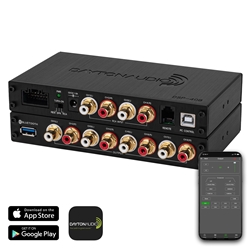
The DSP-408 proves you don’t need to spend $500+ to get real digital signal processing. For around $200, it delivers 4 inputs and 8 outputs built around an Analog Devices ADAU1701 chip, with a 10-band parametric EQ on every output channel, adjustable crossovers, and time alignment.
It’s the right call for a first DSP, a budget-conscious daily driver build, or anyone testing whether DSP tuning is worth the investment before stepping up to a pricier unit. It’s also one of the few processors on this list built to double as a home audio DSP, useful if you tinker with both.
Key Features
Each of the 8 output channels gets its own 10-band parametric EQ plus high and low shelf filters, and crossovers offer selectable Linkwitz-Riley, Butterworth, or Bessel slopes up to 24dB/octave. Time delay adjusts in 1cm increments up to 277cm, which is more than enough resolution for accurate time alignment in any car.
High-level inputs are built in for basic factory-radio integration, and an optional Bluetooth 4.0 dongle (DSP-BT4.0) or wired remote (DSP-NRC) extend it beyond the base Windows software. Dayton backs the DSP-408 with an unusually long 5-year parts and labor warranty for the price.
Why We Recommend It
Anyone building their first active system on a tight budget should start here. It won’t out-tune a Helix or AudioControl unit, but it delivers genuine crossover, EQ, and time-alignment control that most factory head units simply don’t offer, at a price that leaves room in the budget for better speakers.
Pros
- Real 4-in/8-out DSP with 10-band parametric EQ per channel at an entry-level price
- Works in both car and home audio systems
- High-level inputs included for basic factory-radio integration
- Optional Bluetooth dongle and wired remote extend usability
- Backed by a 5-year parts and labor warranty
Cons
- 24-bit/48kHz processing and simpler feature set trail higher-end DSPs
- Windows-only tuning software with a dated interface and no native mobile app
What Customers Say
An Amazon reviewer highlighted the ability to group output channels so EQ and filters apply in unison across multiple speakers, calling it a feature they wished more budget DSPs offered.
Another Amazon reviewer described strong 3.5-volt RMS output and no turn-on or turn-off pop, noting only some sharp edges on the aluminum faceplate as a minor complaint.
How to Buy the Best Car Audio DSP Processor

Picking the right DSP comes down to matching the processor to your system, not just chasing the highest spec sheet. Here’s what actually matters when you’re comparing units, whether you’re keeping the factory head unit or building a fully active aftermarket system from scratch.
Build Quality
Look for aluminum chassis construction, secure RCA jacks that won’t loosen over time, and connectors rated for automotive vibration and temperature swings. Every DSP on this list uses a metal enclosure, which matters more than it sounds since these units often live in tight, heat-affected spaces near an amplifier rack.
Performance
Bit depth and sample rate determine how much headroom the processor has before distortion creeps in. 24-bit/48kHz, like on the Dayton DSP-408, is transparent for most systems, while 32-bit/96kHz options push distortion even lower for competition-grade builds.
Channel Count and Capacity
Count your active zones before you shop: tweeter, midrange, midbass, and subwoofer per side adds up fast. An 8-output DSP covers most 3-way-plus-sub builds, while 10-12 output units handle more complex systems with multiple amplifier stages and additional zones.
Ease of Use
Some processors, like the AudioControl DM-810, use PC or Mac software for the deepest control, while others tune entirely from a phone app. If you’re not planning to pay an installer for tuning, a mobile-app-based DSP will get you further on your own.
Warranty and Support
A digital processor is complex enough that support quality matters when something doesn’t behave as expected. Manufacturers with dedicated knowledge bases, active forums, and multi-year warranties, like Dayton Audio’s 5-year coverage, reduce the risk of being stuck with an unsupported unit down the line.
Price vs Value
A general rule of thumb is budgeting 5-10% of your total system cost toward the DSP. A $200 unit transforms an entry-level build, while a $1,000 processor makes sense once your amps and speakers are already in that territory. Buying above your system’s tier wastes money either direction.
How to Install, Set Up, and Maintain a Car Audio DSP
Most DSPs mount behind the dash, under a seat, or in the trunk near the amplifier rack using included brackets. Keep RCA signal cables physically separated from power wiring to avoid alternator whine, and route the ground wire to a clean chassis point close to the unit rather than daisy-chaining it off another component.
For factory-integrated installs, connect the high-level or signal-summing inputs to the factory speaker wiring exactly as the manual specifies, since reversed polarity here causes phase cancellation that’s hard to diagnose later. Aftermarket source installs are simpler: RCA in from the head unit, RCA out to each amplifier channel.
Initial setup should start with crossovers and time alignment before touching EQ, since correcting the acoustic basics first makes any EQ work afterward more accurate. Save your tuning presets once you’re happy with them, and revisit the settings after any speaker or amplifier changes, since altering one part of the signal chain can throw off previous time-alignment work.
Frequently Asked Questions
Do I need a DSP if I already have a good aftermarket head unit?
Most likely, yes. Even high-end head units have limited crossover slopes and little to no time-alignment capability. A dedicated DSP gives you far more precise control over how each speaker plays, and it becomes essential once you’re running multiple amplifiers or a subwoofer channel.
Can I keep my factory head unit and still use a DSP?
Yes, and it’s one of the most common DSP setups today. Processors with high-level inputs and signal summing, like the AudioControl DM-810 or DM-608, or a plug-and-play unit like the Rockford Fosgate DSR1, let you retain the factory radio, steering-wheel controls, and satellite radio while adding full DSP processing.
What’s the real difference between 24-bit and 32-bit processing?
32-bit processing provides more headroom and lower distortion throughout the signal chain, which matters most for competition-grade sound quality builds. For the vast majority of practical systems, 24-bit at 48kHz or 96kHz is transparent and won’t be the limiting factor in how your system sounds.
Is automatic tuning as good as tuning by ear or with a professional installer?
Measurement-based auto-tuning, like Alpine’s AutoEQ 2.0 on the OPTIM8, is genuinely capable and removes a lot of guesswork from the process. It’s less flexible than a skilled installer’s manual tuning for matching personal taste, so many owners use auto-tune as a strong starting point and refine manually from there.
How much should I actually spend on a DSP?
A reasonable guideline is 5-10% of your total planned audio budget. If your amps and speakers total $2,000, a $200 unit like the Dayton DSP-408 makes sense. If you’re building a $5,000+ competition system, a processor in the $700-1,000 range is a more appropriate match.
Final Conclusion
There’s no single best car audio DSP processor for everyone, but there is a best one for your specific system. If you’re keeping a factory head unit and want the deepest OEM integration toolkit, the AudioControl DM-810 earns the top overall spot. If your vehicle is on Rockford Fosgate’s supported list, the DSR1’s plug-and-play Maestro integration is hard to beat for convenience.
For anyone who wants an amplifier and processor in a single box, the Alpine PXE-C80-88 OPTIM8 solves two problems at once with genuinely useful automatic tuning. The AudioControl DM-608 fills the gap for smaller factory-integrated builds, while the Dayton Audio DSP-408 proves that real processing power doesn’t require a four-figure budget.
Whichever unit you choose, remember that a DSP is only as good as the time you put into tuning it. Start with crossovers and time alignment, save your presets, and don’t be afraid to revisit the settings as your system evolves. That process, more than any spec sheet, is what turns a good system into a great one.
References

Leave a Reply